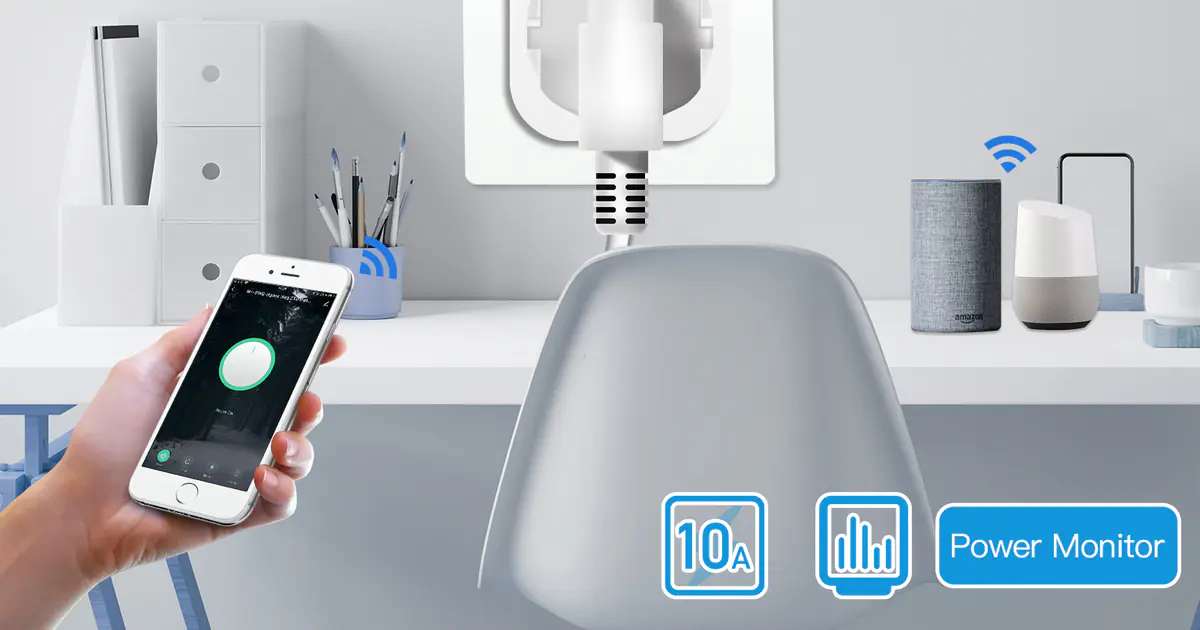
Smart plugs are still the single best entry point into a serious smart-home setup. They are cheap, easy to install (literally plug them in), and they let you take any dumb appliance — a coffee maker, a desk lamp, an aquarium heater, a 3D printer — and bring it under voice control or scheduling. The smart-plug category has matured to the point where AliExpress prices have collapsed and the brands worth buying are clearly separated from the brands worth avoiding. This guide walks through the best AliExpress smart plugs in 2026, the difference between WiFi and ZigBee, and the spec details that actually matter when you are filling a home with twenty of these things.
What to look for in a smart plug
The smart-plug specification market has converged around a few obvious must-haves and a few details that experienced smart-home users care about but newcomers usually ignore.
Current rating in amps. A 10A plug handles up to about 2300W on European voltage or 1200W on US voltage. A 16A plug handles roughly 3700W on European voltage. Match the plug to the appliance: a desk lamp is fine on a 10A unit, but a space heater, kettle, or air conditioner needs the 16A version. Running a high-load appliance on an undersized plug is the most common failure point in cheap smart plugs.
Energy monitoring. Plugs with built-in power measurement let you see real-time wattage and cumulative kWh consumption per device. This is genuinely useful for tracking which appliances cost the most to run and for catching faulty devices that pull too much power. Some plugs report only on/off state with no metering, and those are worth avoiding even at a discount.
Protocol: WiFi or ZigBee or Matter. WiFi plugs connect directly to your router and need no hub, but they hammer your router's connection table when you have twenty of them. ZigBee plugs need a hub (Hue Bridge, SmartThings, ConBee, Sonoff) but mesh together cleanly and respond faster. Matter is the new universal standard that promises to bridge both, but coverage is still thin in 2026. Pick WiFi for a small starter setup of one to five plugs; pick ZigBee if you are scaling past ten plugs.
Tuya app or open ecosystem. The vast majority of AliExpress smart plugs use the Tuya / Smart Life ecosystem, which works with Alexa, Google Home, and increasingly with Home Assistant. Sonoff plugs use the eWeLink ecosystem, which is similar but more niche. Pure Matter plugs work with any hub.
Form factor. Some plugs are bulky enough to block the adjacent outlet on a duplex receptacle. The compact models from Nous, Refoss, and Aubess solve this with side-mounted designs that leave the second socket usable.
Top pick: Nous A1T 16A WiFi Smart Plug with Energy Monitoring
The Nous A1T is the smart plug we recommend to anyone building out a Tuya or Home Assistant setup in 2026. Nous is a Latvian brand whose hardware is sold widely on AliExpress at near-OEM pricing, and the A1T model has become a community favorite in the Home Assistant world for one specific reason: the firmware can be reflashed with Tasmota or ESPHome via the Tuya-Convert process, which means you can run the plug entirely locally without ever talking to the Tuya cloud.
For most users that flexibility is irrelevant — the stock Tuya / Smart Life app works fine and ties into Alexa and Google Home cleanly. What matters more is the spec sheet. The A1T is rated for 16A, which means it can handle pretty much any single-socket appliance in a European home including space heaters, kettles, and even small air conditioners. The energy metering is calibrated reasonably well and reports wattage, voltage, current, and cumulative kWh.
Build quality is genuinely good. The plastic feels dense, the prongs grip the socket firmly without being painful to remove, and the relay clicks crisply on and off. There is a physical button on the side for manual toggling, which is more useful than it sounds when WiFi misbehaves. AliExpress pricing typically lands at $9 to $13 per plug for single units, dropping to $7 to $9 each in four-packs.
The one caveat: the A1T is the EU-plug Schuko version. North American buyers should look at the Nous A5T or the Refoss equivalent for a US-plug version with the same 16A spec.
Best budget option
The generic Tuya WiFi smart plug — sold under dozens of brand names like Aubess, Avatto, BlitzWolf, and various unbranded listings — is the budget answer. These run $4 to $7 per plug in three-packs and use the same Tuya backend as the Nous A1T. The downsides are softer plastic, weaker prongs that loosen over time, and energy monitoring that is often missing or wildly inaccurate. For a single non-critical appliance like a Christmas tree or a fan, these are fine. For anything load-bearing, spend the extra money on a Nous, Refoss, or Sonoff.
Best for ZigBee setups
If you are already running a ZigBee mesh through SmartThings, Hubitat, or a Sonoff dongle, the Sonoff S26 or the Aubess ZigBee plug are the right choice. ZigBee plugs respond faster than WiFi, mesh together so range is not a problem, and do not load up your router's connection table. The Sonoff S26 ZBR2 specifically is a community favorite that pairs cleanly with most ZigBee hubs and supports energy monitoring on the newer revisions.
Expect to pay $10 to $14 per plug, which is a small premium over WiFi but the protocol benefits make it worth it once you pass about ten devices.
Best for high-load appliances
For high-current appliances like space heaters, sauna heaters, or workshop tools, the Refoss 16A plug or the BSEED 20A inline plug are the safer choices. Both come with proper thermal protection and over-current cutoffs that low-end Tuya plugs lack. The Refoss 16A typically runs $14 to $18, and the BSEED 20A runs closer to $25 but accepts loads that would melt a 10A plug.
Always verify the actual amp rating on the device label, not just the listing photo. Some sellers advertise 16A on the listing but ship 10A units.
Other good options
Aubess Tuya WiFi smart plug. A solid budget pick at $5 to $8. Energy monitoring works on most units. Build quality is one tier below Nous.
Refoss 16A smart plug. A direct competitor to Nous with very similar specs. Slightly different aesthetics, slightly higher price (about $11 to $15). Worth a look if Nous is sold out or shipping is slow.
Sonoff S31 Lite. A US-style smart plug with strong build quality and excellent energy monitoring. Runs in the eWeLink ecosystem rather than Tuya, which can be better or worse depending on your existing devices. Around $13 to $17.
Moes Tuya WiFi plug. Moes is another Tuya OEM with a wide AliExpress presence. Specs are virtually identical to Nous; the main difference is availability of specific socket types like UK and Italian standards.
Generic 4-pack bundles. If you have minimal needs and want to fill a closet with cheap controllable outlets, $20 four-packs of unbranded Tuya plugs are everywhere. Read the recent reviews carefully because quality control varies wildly between batches.
How we picked
The recommendations here are based on three filters. First, the plug had to be widely available on AliExpress in 2026 with at least 5000 orders and a 4.7 rating or better. Second, the spec sheet had to match the listing — no obvious lies about amp rating or energy monitoring. Third, the plug had to have working integration with at least one major smart-home platform (Tuya, eWeLink, or Home Assistant) with current users actively reporting success in late 2025 and early 2026.
We also weighted long-term reliability based on community feedback in Home Assistant forums, where users post when plugs die after a year of running 24/7.
Common mistakes to avoid
Undersizing the amp rating. A 10A plug on a 2000W kettle is a fire hazard waiting to happen. Always check the load and pick a 16A plug for anything heat-related.
Buying twenty WiFi plugs without checking your router. Most consumer routers cap connection tables at 32 to 64 devices total. If you load twenty WiFi plugs onto a router that is already serving ten phones and laptops, things break. Use ZigBee for big deployments.
Ignoring the country plug standard. AliExpress lists EU, UK, US, AU, and BR plug variants. Buying the wrong standard means a useless brick when it arrives. Check the seller's listing photo and confirm before ordering.
Trusting cloud-only operation. If your Tuya cloud goes down or the company changes its policies, cloud-only smart plugs become unresponsive. Either run Home Assistant with local Tuya integration, or buy plugs that support local-first protocols like ZigBee or Matter.
Frequently asked questions
Frequently Asked Questions
Yes, almost universally. Tuya / Smart Life plugs (the most common type on AliExpress) integrate cleanly with Alexa and Google Home through the official Tuya skill and action. Sonoff plugs use the eWeLink skill, which works just as well.
WiFi plugs connect directly to your router and need no hub. ZigBee plugs need a ZigBee hub but mesh together for better range and faster response, and they do not consume router connection slots. Use WiFi for one to five plugs; use ZigBee for ten or more.
Only if the amp rating matches the load. A 16A plug with proper thermal protection handles space heaters and kettles safely. A cheap 10A plug pushed past its rating is a real fire risk. Always check the amp rating and prefer known brands like Nous, Refoss, or Sonoff for high-load applications.
Yes. Tuya plugs integrate via the official Tuya integration in Home Assistant or via Local Tuya for cloud-free operation. Some plugs like the Nous A1T can also be flashed with Tasmota or ESPHome for fully local control. Sonoff plugs work via the SonoffLAN integration.
Reputable brands like Nous, Refoss, and Sonoff report power within about three percent of true values, which is good enough for tracking consumption trends. Bargain unbranded plugs are often off by ten to twenty percent, which makes them useless for serious energy auditing.
Usually it is a router issue. Older routers and mesh systems can drop low-bandwidth IoT devices when their connection tables fill up. Move smart-home devices to a dedicated 2.4GHz network if your router supports band separation, and consider moving to ZigBee for large deployments.
Final recommendation
For most smart-home builders in 2026, the Nous A1T 16A WiFi smart plug is the right choice — it is well built, has accurate energy monitoring, supports both Tuya cloud and local control, and is priced fairly even at single-unit quantities. Buy three or four to start, see how you use them, and then decide whether to scale up on WiFi or switch to ZigBee for your next batch. If your budget is genuinely tight, the generic Tuya 4-pack bundles will get you started; just do not put them on anything that pulls heavy current.