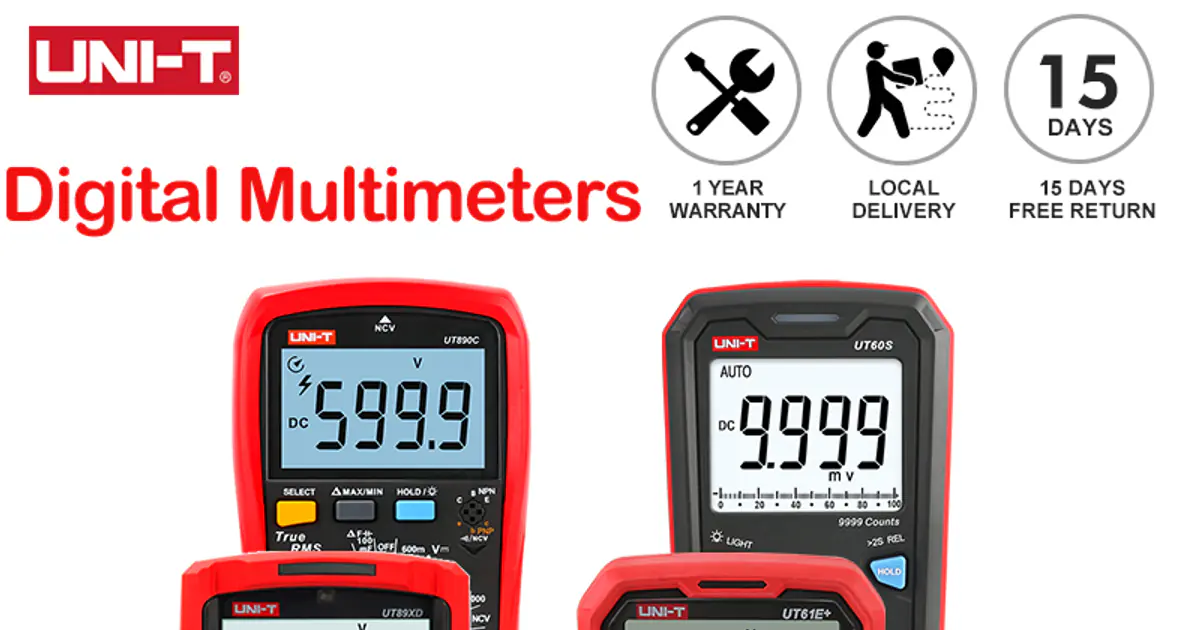
Most digital multimeters under $30 measure voltage well enough for basic household troubleshooting. The UNI-T UT61E is a different category of tool. With a 22,000-count display, True RMS AC measurement, RS232 data logging to a PC, and CAT III 600V safety certification, it punches well above its AliExpress price tag of roughly $40–55 (check the current listing — prices vary by seller and promotion).
If you work on electronics, repair equipment, or need reliable measurements beyond "is this outlet live," the UT61E deserves serious consideration. Here's what it does, what it doesn't, and how it stacks up against the Fluke 117 and the AstroAI AM33D.
Measurement Capabilities and Accuracy
The UNI-T UT61E measures: AC voltage, DC voltage, AC current, DC current, resistance, capacitance, frequency, and diode/continuity. Auto-ranging is active by default — the meter selects the appropriate range for your input signal automatically, which is faster and safer than manual ranging for beginners.
The 22,000-count display is the first thing that separates the UT61E from basic multimeters. A typical cheap multimeter shows 2,000 counts — meaning it can display values up to 1,999 before it needs to switch ranges. At 22,000 counts, the UT61E resolves measurements to far finer detail. For DC voltage at the 2V range, that works out to 0.1mV resolution — useful when you're measuring reference voltages in a microcontroller circuit or checking a precise voltage regulator output.
True RMS is the other critical differentiator. Average-responding multimeters calculate AC voltage assuming a perfect sine wave. Real-world signals from switching power supplies, motor drives, variable-frequency drives, and dimmer circuits are not perfect sine waves — they're distorted waveforms where average-responding meters give significantly wrong readings. True RMS measures the actual root-mean-square value of the waveform, regardless of its shape. For electronics and electrical work involving modern equipment, True RMS is the correct measurement. The UT61E delivers it at a price where competitors still offer average-responding meters.
Accuracy specs (per UNI-T):
- DC Voltage: ±0.5%
- AC Voltage (True RMS): ±1.0%
- DC Current: ±1.0%
- Resistance: ±1.0%
- Capacitance: ±3.0%
These are typical specs for a mid-range professional meter — not Fluke-tier, but well beyond casual-use budget meters.
Auto-Ranging and Special Measurement Modes
Auto-ranging on the UT61E is fast by budget meter standards — range switching happens within a second or two, which keeps your workflow moving. Manual range selection is available if you need it (hold the RANGE button while in auto mode to lock).
Data Hold freezes the display reading so you can note a measurement made in an awkward position without the value updating while you move the probes.
Relative (REL) mode subtracts the current reading from future readings — useful for measuring small resistances above the meter's lead resistance, or checking small capacitance values above your probe capacitance.
Max/Min recording captures the peak high and low readings during a measurement session — helpful for catching transient voltage spikes or tracking a fluctuating value over time.
Frequency measurement works up to 22 kHz — adequate for audio work, mains frequency checking, and most digital signal frequencies in microcontroller projects. Not useful for RF work.
The continuity buzzer responds quickly — under 5ms — which matters when you're chasing a break in a cable or PCB trace and need audible feedback as you probe.
PC Interface and Data Logging via RS232
This is a feature most sub-$100 meters don't offer, and it's one of the UT61E's key differentiators for serious users.
The UT61E has an RS232 optical interface that transmits measurement data to a PC in real time. A USB-to-RS232 optical adapter (often included in the AliExpress bundle — check the seller's listing) connects to any PC. Free software (UNI-T ships a basic app; the open-source community has built better alternatives including DMM software compatible with the UT61E protocol) lets you log readings, plot graphs, and record time-stamped measurement sessions.
For electronics debugging, this is legitimately useful: you can capture a battery discharge curve, log temperature sensor voltages over an hour, or track a power rail during startup — all hands-free once the probes are in place.
One honest note: the RS232 adapter cable is a legacy interface. Some laptops don't have RS232 headers and will need a USB-to-serial adapter, which is usually cheap (a few dollars on AliExpress). Most modern builds handling this through software work fine.
Safety: CAT III 600V Rating
The UNI-T UT61E carries a CAT III 600V safety rating. This means it's rated for use in fixed electrical installation environments — distribution boards, bus bars, and any equipment up to 600V in a CAT III environment. For electronics workbench use (low voltage, power supplies, hobby circuits), this rating is significant overkill — which is exactly what you want. A meter with insufficient category rating that's used near mains voltage can arc-flash violently if it encounters a transient spike.
For home DIY electrical work (outlets, light fixtures, consumer appliances), CAT III 600V is appropriate and safe. For hobby electronics on a workbench (microcontrollers, audio circuits, PCBs), you'll never approach the limits.
The probes included in the AliExpress version are rated to a lower CAT standard than the meter itself — a known limitation of budget meters. If you're doing mains-voltage work, invest $10–15 in proper CAT III-rated test leads separately. For benchtop electronics work, the included probes are fine.
UNI-T UT61E vs. Fluke 117 vs. AstroAI AM33D
vs. Fluke 117 (~$150–180): Fluke is the gold standard for professional electricians. The 117 adds a non-contact voltage detector, better build quality, and Fluke's legendary reliability record. Its display is 6,000 counts — less than the UT61E's 22,000. The UT61E wins on display resolution and adds PC data logging the Fluke 117 doesn't have. The Fluke wins on brand trust, warranty, and proven long-term reliability. If your livelihood depends on your multimeter, buy the Fluke. If you're a hobbyist or engineer who can tolerate the small risk of a budget brand, the UT61E at one-quarter the price is hard to argue against.
vs. AstroAI AM33D (~$18–22): The AstroAI is a capable basic meter for household use. It's average-responding (not True RMS), has a 2,000-count display, and no PC interface. At under $20 it's a good first meter. But if you're working with electronics or any non-sinusoidal AC, the UT61E's True RMS and 22,000-count precision are worth the additional $25–35.
The UNI-T UT61E is the most capable sub-$55 multimeter available — True RMS, 22,000-count precision, PC data logging, and CAT III 600V safety certification at a fraction of the Fluke price.
Pros
- ✓True RMS measurement gives accurate readings on non-sinusoidal waveforms from modern electronics
- ✓22,000-count display resolves measurements to 0.1mV in fine ranges — far beyond typical budget meters
- ✓RS232 PC interface enables real-time data logging and graph plotting for serious debugging work
- ✓CAT III 600V safety rating makes it appropriate for mains electrical work and bench use alike
- ✓Auto-ranging with fast response, plus data hold, REL mode, and max/min recording
- ✓Exceptional value at $40–55 compared to Fluke equivalents at $150+
Cons
- ✗RS232 optical interface is a legacy standard — most users will need a USB-to-serial adapter not always included
- ✗Included test probes may not be CAT III rated — replace them if working near mains voltage regularly
- ✗Build quality feels slightly plastic-y compared to Fluke; rubber holster helps but it's still a budget feel
- ✗No built-in non-contact voltage tester (NCV) — the Fluke 117 includes this as a bonus safety feature
Buy if...
- •Electronics hobbyists, makers, and engineers who need True RMS accuracy and high display resolution for bench work
- •Amateur electricians who want a proper CAT III safety-rated meter for household wiring work without paying Fluke prices
- •Repair technicians who want PC data logging to capture and analyze measurement sessions over time
- •Anyone upgrading from a basic 2,000-count average-responding meter who wants real precision
Skip if...
- •Working professionals whose income depends on their meter — choose a Fluke 117 or 115 for proven durability and warranty support
- •Casual users who just need to check if an outlet is live — the AstroAI AM33D at $20 is entirely sufficient for basic household use
- •Users who need built-in non-contact voltage detection — the UT61E doesn't have NCV; check the Fluke 117 or Klein MM400 instead
Verdict: Should You Buy the UNI-T UT61E?
At $40–55 on AliExpress (prices vary — check before buying), the UNI-T UT61E offers True RMS accuracy, 22,000-count resolution, PC data logging, and CAT III 600V safety. In any other brand's catalog, those specs would cost $100–150.
For electronics hobbyists, makers, repair techs, and serious DIYers, this is the multimeter to own. It's not perfect — the included probes are basic, the RS232 interface is dated, and Fluke still wins on build quality and reliability — but for the price, nothing on AliExpress comes close to what the UT61E delivers.
Frequently Asked Questions
Average-responding meters calculate AC voltage assuming a perfect sine wave and multiply the average by 1.1107 to estimate RMS. This works for pure sine waves from the power grid, but modern electronics — switching supplies, variable frequency drives, dimmers — produce distorted waveforms. For those, average-responding meters give readings that are 5–50% off. True RMS meters like the UT61E measure the actual mathematical RMS value of any waveform, giving accurate results regardless of waveshape.
UNI-T ships basic Windows logging software with the UT61E. The RS232 optical protocol is well-documented and supported by several open-source alternatives — search for 'UT61E software' to find community options with better graphing and export features. Most setups require a USB-to-RS232 optical adapter (often included in AliExpress bundles; check your seller's listing).
IEC 61010 defines measurement categories (CAT I through CAT IV) based on the severity of transient overvoltages a meter may encounter. CAT III 600V covers fixed electrical installations — distribution boards, building wiring, and industrial equipment up to 600V. The rating means the meter can survive voltage spikes in those environments without arcing or catastrophic failure. For hobby electronics workbench use, this is generous headroom. For household electrical work, it's appropriate. Using an under-rated meter in a mains environment is a real safety risk.
The UT61 series shares a platform. The UT61E is the top of the range with 22,000 counts and full measurement capabilities including True RMS. The UT61D offers 22,000 counts but with slightly reduced measurement functions. The UT61C is the entry-level variant with fewer modes. For most buyers, the UT61E is the clear choice — the price premium over the UT61C is small for the feature delta.
AliExpress sellers typically offer the UT61E between $40 and $55 depending on seller, included accessories, and promotions — check the current listing, as prices fluctuate. Some sellers include the RS232 optical cable and test leads in the bundle; others sell them separately. Verify what's included before purchasing. UNI-T also sells through Amazon and its own official store at higher prices.