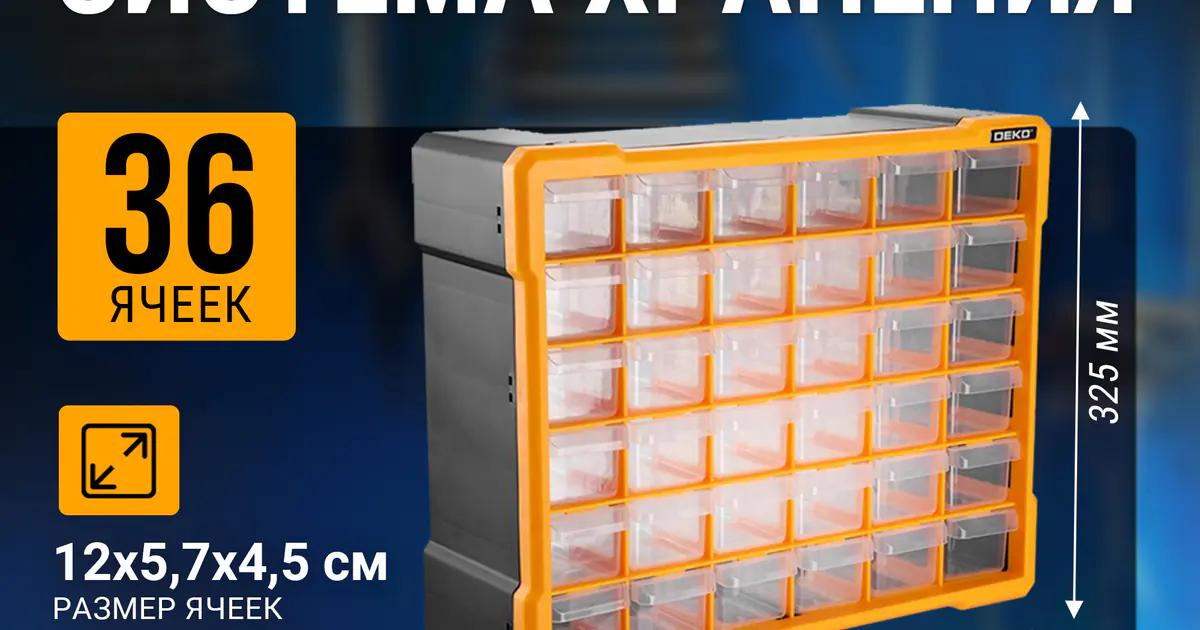
Small-parts chaos is the tax you pay for having hobbies. Screws mixed with nuts mixed with connectors, fishing lures tangled in a tackle box, resistors in an unmarked bag — it all costs time you could be spending actually building or fixing things. The DEKO Stackable Storage Organizer addresses this with a 36-cell ABS case system designed to stack, latch, and carry as a single unit.
At under $25 on AliExpress (check the current listing — prices fluctuate), it competes aggressively with the Stanley Fatmax organizer and undercuts the German Sortimo L-BOXX system by an order of magnitude. Here's a thorough look at what you actually get.
Build Quality and Material
The DEKO organizer uses ABS (Acrylonitrile Butadiene Styrene) plastic — the same material used in LEGO bricks and most quality tool housings. It's rigid, impact-resistant, and doesn't flex significantly under load. The panel thickness on the cell dividers is approximately 2–3mm, which feels more substantial than the thin-walled cheapest Amazon organizers but won't be mistaken for injection-molded German engineering.
The external case dimensions are approximately 340mm × 240mm × 85mm (check the specific listing — dimensions vary slightly between product runs). That makes it large enough to hold a meaningful number of parts, small enough to fit in a workshop drawer or a backpack side pocket.
Cell configuration: 36 cells in a 6×6 grid. The individual cells are not reconfigurable on this model — each cell is fixed at approximately 35mm × 35mm × 70mm deep. If you need adjustable-size compartments, look for DEKO's "adjustable" variant (the cell counts differ, and dividers can be repositioned). The fixed-cell version reviewed here is better for users who have many categories of small, similar-sized parts — screws, fishing lures, seed beads, SMD components.
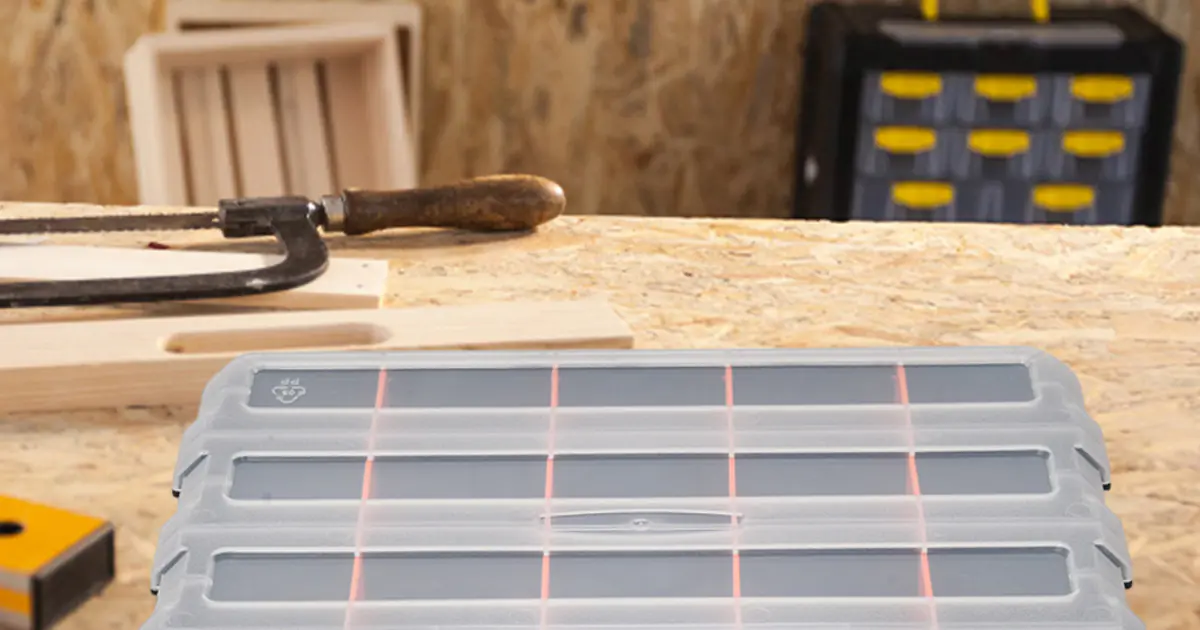
The lid is clear polycarbonate or thick transparent ABS — you can see the contents without opening. This sounds minor but saves a surprising amount of time in a busy workspace.
Latch System and Stackability
The latching system is where the DEKO earns a meaningful advantage over cheaper organizers. Two side latches per case use a positive-click engagement — when the latch clicks, the lid is secured. Cases dropped from counter height (around 90cm) in user reports generally survive without latches failing or contents spilling, which is the real-world test that matters.
The stack interface uses a patented (or at least designed) groove-and-ridge system on the top and bottom of each case. Cases seat onto each other and don't slide laterally when stacked. More importantly, the latches on each case reach through and lock to the case above when the stack is latched together — this is the key feature. A stack of two or three DEKO organizers can be lifted by the top case's carry handle without the lower cases separating. That's not a guarantee you'll want to do this with a heavily loaded three-case stack, but for a light load it's practical for carrying from workbench to vehicle.
The carry handle is integrated into the lid, folds flat when not in use, and is rated for the weight of a single case of parts. It's not designed for carrying multiple stacked cases by one handle at full load — use both hands if the stack is heavy.
Latch concern: the latch tabs are plastic and will fatigue over time with frequent opening and closing. At moderate use (a few times per week), they should last years. Heavy commercial daily use is another story — for that, the Stanley Fatmax with its more robust latch mechanism is the better choice.
Storage Capacity and Use Cases
36 cells at approximately 35mm × 35mm × 70mm each gives you a useful volume per cell. What actually fits:
Hardware and fasteners: Each cell holds approximately 50–80 M3 screws, or 30–40 M4/M5 screws. A full case covers all common metric screw sizes with room for washers and nuts in separate cells. A hardware drawer that used to be an unsorted nightmare becomes navigable in a single afternoon.
Electronics components: SMD resistors and capacitors in tape segments, through-hole resistors bundled in groups, small ICs in ESD bags, terminal blocks, JST connector pairs — a 36-cell case covers almost all the passive components a hobbyist accumulates. Keep an ESD-safe mat under the case if you're handling CMOS ICs.
Fishing tackle: Fishing lures, swivels, hooks in multiple sizes, split rings, bobbers — this is one of the original use cases for cell organizers. The 35mm cell width handles most lure hooks without tangling. Some anglers report keeping the case in a backpack for shore fishing.
Beads and jewelry: Seed beads, bugle beads, findings, jump rings, clasp types — this is the beading/jewelry maker's standard storage solution. Multiple DEKO cases stacked by color family or material type.
3D printing accessories: PTFE tube segments, bed clips, nozzles by size, belt tensioners, small hardware for printer maintenance. A single 36-cell case covers most of a printer's consumables inventory.
Hobby model kits: Small plastic or resin parts sorted by assembly stage or subassembly. Paints in small dropper bottles (check the lid height — some dropper bottles are too tall for 70mm cells).
DEKO vs. Stanley Fatmax Organizer vs. Sortimo L-BOXX
vs. Stanley Fatmax Deep Pro Organizer (~$35–45): The Stanley Fatmax has a more robust latch mechanism, a higher-quality ABS feel, and Stanley's brand backing. The Fatmax uses adjustable dividers rather than fixed cells — better if your parts vary significantly in size, worse if you want a consistent grid. The Stanley's stack system also mates with other Stanley modules and some compatible brands. For professional tool use or demanding workshop conditions, the Stanley is the better choice. For hobby use at home, the DEKO saves $15–20 for similar functionality.
vs. Sortimo L-BOXX system (~$80–150+ per module): Sortimo is German professional-grade equipment designed for daily commercial use. The L-BOXX interlocking system is engineered for van storage and field service, with locking mechanisms that survive van loading. The cost is proportional. At 5–6x the DEKO's price, Sortimo is not a realistic comparison for hobbyists — it's here for context. If you're a field electrician or plumber who needs a tool storage system that survives commercial abuse, the Sortimo is worth every cent. For workbench or home hobby use, the DEKO is the rational choice.
Honest Limitations
The fixed 36-cell grid is the most significant limitation. If you want to store items that vary significantly in size — both M2 screws and M12 bolts in the same case, or both small resistors and larger capacitors — the fixed cells are limiting. The adjustable-divider DEKO variant, or the Stanley Fatmax's adjustable system, is a better match.
At 70mm depth, the cells won't hold tall items. Bottles of flux, taller thread-lock tubes, or long drill bits don't fit standing upright. For deeper storage, look for other organizer formats.
The clear lid scratches with use — fine sand or grit will produce surface marks that make it harder to read the contents through the lid over time. Cleaning gently with a microfiber cloth helps.
The DEKO 36-cell stackable organizer is the best value small-parts storage system under $25 — reliable latching, useful clear lid, and genuine stackability make it a workshop and hobby essential.
Pros
- ✓36 fixed cells in a consistent grid — ideal for parts with many categories and similar sizes
- ✓Clear polycarbonate lid lets you see contents without opening
- ✓Positive-click latches secure the lid reliably; cases can be stacked and carried as a unit
- ✓Groove-and-ridge stack interface prevents lateral sliding between stacked cases
- ✓ABS construction is stiff and impact-resistant at the price point
Cons
- ✗Fixed cells cannot be reconfigured — a poor fit for items that vary significantly in size
- ✗70mm cell depth limits tall items; bottles and long components don't fit upright
- ✗Clear lid scratches with regular use — handle gently and avoid abrasive cleaning
- ✗Plastic latches will fatigue under very frequent use — not designed for commercial daily cycling
- ✗Stackability works best with identical DEKO cases — cross-brand stacking is not guaranteed
Buy if...
- •Electronics hobbyists who need to sort resistors, capacitors, connectors, and small ICs into a consistent grid system
- •Anglers who carry multiple lure and tackle categories to the water and want organized, portable storage
- •Hardware collectors who want to sort screws, nuts, and washers by size into a visually clear system
- •Makers and 3D printing enthusiasts managing a growing inventory of small parts and printer consumables
Skip if...
- •Professional field technicians who need a robust commercial-grade system — choose the Sortimo L-BOXX or Stanley Fatmax for daily field use
- •Users who need to store items of highly variable sizes in the same case — choose the adjustable-divider DEKO variant or Stanley Fatmax instead
- •Anyone storing tall components (flux bottles, long drill bits, tall capacitors) — the 70mm cell depth won't accommodate them upright
Final Verdict: Is the DEKO Organizer Worth Buying?
At under $25 on AliExpress, the DEKO 36-cell stackable organizer is hard to argue against for home hobbyists. The fixed cell grid works well for anyone with parts that fall into consistent size categories — hardware, electronics components, fishing tackle, beads — and the stackability with carry-as-a-unit function is genuinely useful.
It's not a Stanley Fatmax and certainly not a Sortimo. But for home workshop and hobby use, it doesn't need to be. If you're spending time hunting for parts in an unsorted drawer, the DEKO will solve that problem immediately and cost less than a single dinner out.
Frequently Asked Questions
The DEKO stack interface is designed for DEKO-to-DEKO stacking. It may not be compatible with Stanley, Sortimo, or other brand cases. The groove-and-ridge interface dimensions are proprietary. Buy matching DEKO cases if stackability between cases is important to your use case.
Approximately 50–80 M3 screws per cell, depending on head type and length. M4 screws fit 30–40 per cell. M5 and M6 screws around 20–30 per cell. A full 36-cell case can accommodate a comprehensive metric screw and nut collection for a well-stocked home workshop.
Yes, with a caveat: the case itself is not anti-static. For moisture-sensitive components, the case provides good physical organization. For ESD-sensitive components (CMOS ICs, MOSFETs, certain sensors), keep them in their original ESD bags inside the cells, and handle on an ESD-safe mat. The case works well for resistors, capacitors, connectors, and other components that are not ESD-sensitive.
DEKO's latching system is designed to allow stacked cases to be carried as a unit when latched together. In practice, this works well for light to moderate loads across two cases. For three stacked cases with heavy parts (metal hardware), use both hands and exercise caution. The handle and latches are designed for convenience, not for repeated heavy lifting.
The fixed 36-cell model reviewed here has permanent cell walls in a 6x6 grid — all cells are the same size. The adjustable-divider variant has a larger open tray with movable plastic dividers that let you create cells of different sizes. Choose fixed for consistent small-parts sorting (screws, electronics, lures). Choose adjustable if your items vary in size and you want flexibility to reconfigure the layout.