Smart speakers have quietly become the control center of the modern smart home. You ask one to turn off the lights, set a timer, play music, or check the weather — and it just works. But with dozens of models available and three competing assistant ecosystems (Google Assistant, Amazon Alexa, and Siri/HomeKit), picking the right one is less obvious than it looks.
The good news: you don't need to spend $100 on a Google Nest Audio or Amazon Echo to get a genuinely capable smart speaker. Several excellent options are available on AliExpress for $30–$70, offering real audio quality, solid assistant performance, and smart home integration that rivals the big names.
This guide covers everything you need to know before buying — what the specs mean, which assistant ecosystem to choose, privacy considerations, and five specific recommendations across a range of budgets and use cases.
What to Consider Before Buying a Smart Speaker
Sound Quality: What the Specs Actually Mean
Smart speaker audio is one of those areas where marketing numbers are particularly unhelpful. "12W" sounds impressive on a spec sheet, but wattage doesn't map directly to perceived loudness or quality — it depends on driver efficiency, enclosure design, and digital signal processing.
Here's a more useful frame for evaluating sound quality in this category:
Driver size matters. A larger driver (60mm+) can produce more bass extension than a small one. Single-driver designs (one full-range driver) are common at budget price points. Two-driver designs (tweeter + woofer) generally produce better separation of highs and lows.
Room-filling capability. A smart speaker that sounds fine at 50% volume in a bedroom may struggle in a large living room. If you want to fill a 30-square-meter room without distortion, look for 12W+ output or a two-driver design.
DSP processing. Many speakers use digital signal processing (DTS, Dolby, or proprietary algorithms) to artificially widen the soundstage or boost bass. Results vary — some implementations are genuinely useful, others just add muddiness. DTS is generally a reliable standard.
Voice call quality. If you plan to use the speaker for hands-free calls, check the microphone quality. Far-field microphones with noise cancellation mean the speaker can hear you from across the room even with music playing.
Choosing Your Assistant Ecosystem
This is the most important decision, and it's one you should make before looking at specific hardware. The three main ecosystems:
Google Assistant is the most capable voice assistant for natural language queries and smart home control with a broad range of compatible devices. It works best if you use Google services (Gmail, Calendar, YouTube, Spotify, Google Maps) and Android phones. Smart speakers running Google Assistant connect to Google Home.
Amazon Alexa has the largest third-party skill library and the widest device compatibility. It works best if you're invested in Amazon's ecosystem (Prime, Fire TV, Ring cameras). Alexa speakers connect to the Amazon Alexa app.
Apple Siri / HomeKit is the right choice if you're all-in on Apple — iPhone, Apple Watch, Apple TV, Mac. HomeKit has the strongest privacy record of the three and requires the least cloud dependency, but device compatibility is more limited.
The critical point: buy hardware that matches your assistant. A Google Assistant speaker in an Alexa household creates constant friction. A speaker in the wrong ecosystem is worse than no smart speaker at all.
Smart Home Integration
A smart speaker's value as a control hub depends entirely on which devices it can control. Broadly:
- Google Home devices can be controlled by Google Assistant speakers (and now Matter-compatible devices via Google Home)
- Amazon Smart Home devices work with Alexa speakers
- HomeKit devices work with Apple speakers (HomePod, HomePod mini)
- Matter is the new cross-platform standard — devices with Matter certification work across all three ecosystems
If you're starting fresh, Matter-compatible devices give you the most flexibility regardless of which smart speaker you choose.
For smart lights specifically: Philips Hue, LIFX, and most Xiaomi/Yeelight smart bulbs are Google Home and Alexa compatible. Smart plugs from TP-Link (Kasa/Tapo), Xiaomi, and Meross also support multiple ecosystems.
Multi-Room Audio
If you want music to play in multiple rooms simultaneously, you need speakers that support the same multi-room protocol:
- Google Cast (Chromecast built-in): Works across Google Home speakers, select Sonos speakers, and third-party Cast-enabled speakers. Free, no subscription.
- Amazon Echo Multi-Room Music: Works across Echo devices. Free for Prime subscribers.
- AirPlay 2: Works across HomePod, Apple TV, and AirPlay 2-compatible speakers. Best with Apple devices.
Xiaomi's Mi Smart Speaker supports Google Cast, so it works in a multi-room Google Home group. Amazon Echo devices support Amazon's proprietary protocol. You can't mix ecosystems in a multi-room group — all speakers in a room group need to support the same protocol.
Privacy: What Happens to Your Voice Data
Every smart speaker with a wake word (Hey Google, Alexa, Hey Siri) has its microphone active and listening for that phrase in the background. When you trigger the wake word, the audio is sent to the assistant's cloud servers for processing. This is unavoidable with voice-activated AI — the processing happens in the cloud.
What varies between platforms:
- Google: Stores voice recordings for review; you can delete history via myaccount.google.com. Has been criticized for third-party contractor review of recordings, though opt-out is available.
- Amazon: Similar recording and review practices. Alexa Privacy settings let you delete recordings and opt out of human review.
- Apple (HomePod): Audio is processed on-device where possible; what is sent to Apple is anonymized and not linked to your Apple ID. Generally considered the most private.
If privacy is a top concern, consider:
- Buying a speaker with a physical microphone mute button (hardware-level disconnect)
- Using the speaker on a separate IoT WiFi network
- Deleting voice history regularly in the assistant app
All speakers on this list have physical mic mute buttons.
Use Cases: Matching Speaker to Room
Bedroom: Small, compact speaker with good alarm and sleep timer integration. The Xiaomi Mi Smart Speaker or Echo Dot are ideal. You don't need room-filling volume.
Kitchen: Hands-free convenience matters most — asking for recipes, timers, unit conversions. Any speaker works here. Water-resistant would be nice (none of the models below are splash-proof, so keep them away from the sink).
Living room: Sound quality and volume matter more here. Look for 12W+ output or a two-driver design. The Anker Soundcore Smart Speaker or Amazon Echo (4th gen) are better choices for a large living room than a compact Dot or Mini.
Home office: Smart speaker for focus music and hands-free calls. Google Assistant's Google Meet / Google Duo integration or Alexa's calling features are useful. A medium-sized speaker works well.
Children's room: Alexa has the best parental controls and a dedicated "Kid Mode." Google Assistant's child accounts (via Family Link) offer similar controls.
5 Best Smart Speakers to Buy on AliExpress in 2026
1. Xiaomi Mi Smart Speaker — Best Overall Value
Price: approximately $35–$55 | Assistant: Google Assistant | Output: 12W | Dual-band WiFi
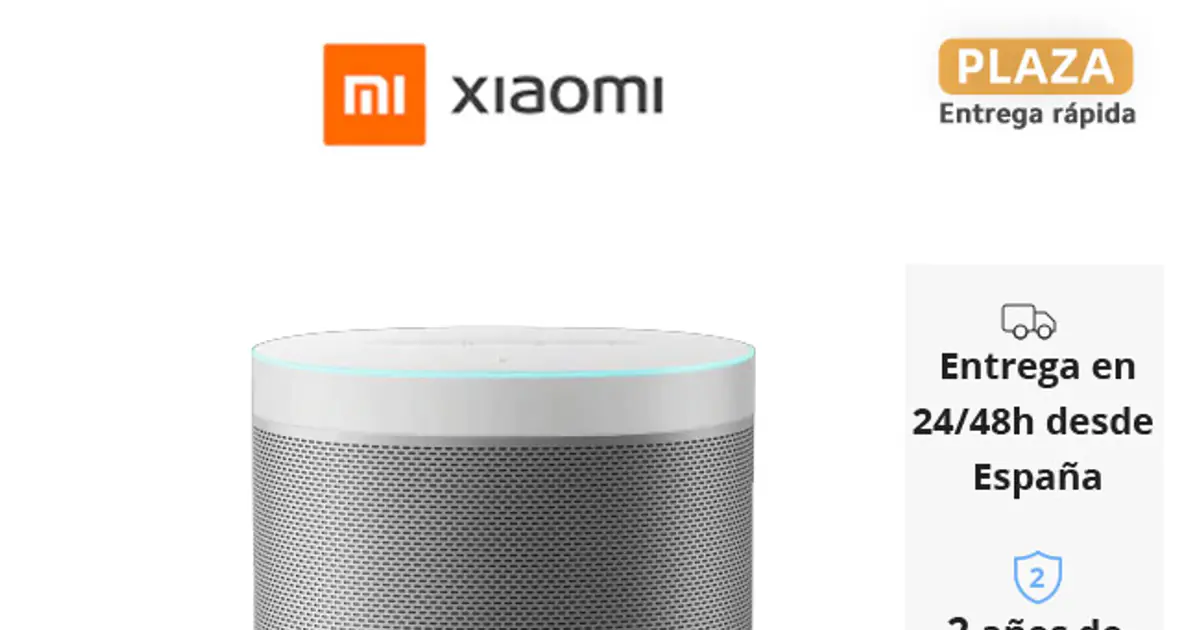
The Xiaomi Mi Smart Speaker 12W WiFi Bluetooth DTS Sound is our top pick for most buyers. It runs Google Assistant natively (not a China-market-only assistant), supports dual-band WiFi (2.4GHz and 5GHz), and produces genuinely good audio from its 63mm driver with DTS processing.
The 12W output is significantly more powerful than the Google Nest Mini and roughly matches or exceeds the Echo Dot 5th Gen. Bass extension is warm and present at moderate volumes, and the DTS processing adds soundstage width that makes it feel larger than it is.
As a Google Home speaker, it integrates with any Google-compatible smart home device — lights, plugs, thermostats, cameras, and Xiaomi's own Mi Home ecosystem. Multi-room audio via Google Cast is supported.
Design is clean and compact — fabric-wrapped cylinder that looks at home on a nightstand or kitchen counter. Dual-band WiFi is a practical advantage over the Nest Mini in crowded apartment buildings.
Verdict: The best balance of audio quality, smart home integration, and price on AliExpress in 2026.
2. Amazon Echo Dot (5th Gen) — Best for Alexa Users
Price: approximately $40–$55 (varies by region) | Assistant: Amazon Alexa | Output: 3.5W + eero built-in
If you're in an Amazon household — Prime subscription, Fire TV, Ring cameras — the Echo Dot 5th Gen is the right speaker. It's not the loudest (3.5W is modest), but Amazon improved audio quality significantly with a bigger driver and surface-sensing vibration reduction technology in the 5th gen.
It has a 3.5mm audio output for connecting to external speakers, which none of the other compact speakers on this list offer. Alexa's skill library is the largest of any smart assistant, and integration with Amazon's own devices (Fire TV, Ring, Blink) is seamless.
On AliExpress, Echo Dots ship from third-party sellers. Check seller ratings carefully — some listings are from unofficial importers. Amazon's official regional stores are usually the most reliable source.
Verdict: Best choice for Alexa ecosystems; audio is decent but not the loudest option.
3. Anker Soundcore Smart Speaker — Best Audio Quality
Price: approximately $45–$65 | Assistant: Alexa built-in | Output: 10W+
Anker's Soundcore brand makes some of the best-value Bluetooth speakers on the market, and their smart speaker models bring that audio pedigree to the smart speaker category. The Soundcore Smart Speaker (various models under this line) typically offers 10–20W output, a larger driver than most compact smart speakers, and BassUp technology for enhanced low-frequency response.
Unlike the Xiaomi and Echo Dot, the Soundcore leans into audio quality as its primary feature — it competes with dedicated Bluetooth speakers and happens to include Alexa. If you care more about music listening than smart home control depth, this is the pick.
Availability on AliExpress varies by model. Check current listings for the Soundcore Infini or Soundcore Boost for the best audio-focused options.
Verdict: Best choice for music-focused buyers who want Alexa in a speaker that genuinely sounds good.
4. Tribit StormBox Micro 2 with Google Cast — Best Portable Option
Price: approximately $40–$55 | Assistant: Google Assistant (via Cast) | Output: 12W | IP67
The Tribit StormBox Micro 2 is not strictly a smart speaker — it's a portable Bluetooth speaker with Google Cast built in via a companion app integration. But for buyers who want portable freedom as well as smart home connectivity, it's worth considering.
At 12W with IP67 waterproofing, the StormBox Micro 2 sounds excellent for its size and can go from bathroom shelf to backyard without concern. It's not a standalone Google Assistant device — you can't talk to it directly without your phone nearby — but you can cast music to it from Google Home and group it with other Cast speakers.
If you want a speaker you can take camping but also use on your desk for Google Home control, this is the creative solution.
Verdict: Best for buyers who want portability and smart home compatibility in one device.
5. Xiaomi Mi Smart Speaker IR Control — Best for Xiaomi Smart Home Users
Price: approximately $45–$65 | Assistant: Google Assistant / Mi AI | Output: 12W | IR Blaster
For buyers deep in the Xiaomi smart home ecosystem, there's a variant of the Mi Smart Speaker that includes an IR blaster — letting it control any IR-based device (TVs, air conditioners, fans) in addition to WiFi-connected smart devices.
This is a significant practical advantage: many homes have older appliances that don't have WiFi connectivity, and an IR blaster turns the speaker into a hub that can control them all by voice. "Hey Google, turn on the air conditioner" becomes genuinely useful if the speaker can blast an IR command to your AC unit.
The IR version costs a bit more but is worth it for buyers with multiple IR-controlled appliances. Available on AliExpress and Xiaomi's regional stores.
Verdict: Best for Xiaomi ecosystem users who want voice control over non-smart appliances.
Setting Up Your Smart Speaker for the Best Experience
Initial Setup Tips
Most smart speakers set up through a smartphone app (Google Home for Google Assistant speakers, Amazon Alexa app for Echo devices). The process takes 5–10 minutes. A few tips to make it smoother:
- Have your WiFi password ready — you'll need it during setup.
- Place the speaker where you'll actually use it first — you can always move it later, but setup on location makes the WiFi test more accurate.
- Use the same account for all your smart devices — linking everything under one Google or Amazon account makes multi-room control and routines much easier.
Routines and Automation
The most underused feature of smart speakers is routines — automated sequences triggered by a voice command, a time, or a sunrise/sunset. A few practical examples:
- "Hey Google, good morning" → turn on bedroom lights to 30%, play the news, announce today's weather and calendar.
- "Alexa, movie time" → dim living room lights to 20%, turn on the TV and streaming device, set the speaker to low volume.
- "Hey Google, goodnight" → turn off all lights, lock the front door (if you have a compatible smart lock), set a morning alarm.
Routines are set up in the Google Home or Alexa app and take about 2 minutes per routine. They dramatically increase daily utility.
Voice Match and Multiple Users
Both Google Assistant and Alexa support voice profiles — the speaker recognizes individual voices and personalizes responses. Set up voice match for everyone in the household so each person gets their own calendar, reminders, and music preferences.
Keeping It Secure
- Enable purchase confirmation codes — prevents accidental purchases via voice.
- Review voice history monthly — delete recordings you don't need.
- Use the microphone mute when hosting guests — if you're not comfortable with a hot mic during a party, mute it physically.
- Keep firmware updated — smart speakers receive over-the-air updates automatically, but check periodically in the app.
Frequently Asked Questions
Yes. Google Assistant supports dozens of languages and regions. During setup in the Google Home app, select your language and region. Most features — music, smart home control, queries — work globally, though some region-specific features (like local business search or live traffic) vary.
Initial setup requires a smartphone and the companion app (Google Home or Amazon Alexa). After setup, day-to-day use is hands-free via voice — no phone needed. The phone only comes back into play for changing settings or installing app updates.
In Google Home, go to Settings → Rooms and Groups, create a group, and add your speakers. In the Alexa app, go to Devices → Plus icon → Combine Speakers. Once grouped, saying 'play music everywhere' or 'play in kitchen and living room' routes audio to all speakers in the group simultaneously.
For established brands like Xiaomi, Anker/Soundcore, and TP-Link/Tapo, AliExpress listings from official brand stores or high-rated third-party sellers are legitimate. Be cautious with no-name brands and check seller reviews carefully. Amazon Echo devices are sometimes sold by third-party importers — these are generally fine but check the firmware version and warranty.
AliExpress typically has the best prices on Xiaomi and Anker smart speakers. For Amazon Echo, Amazon's own regional stores often match or beat AliExpress for established markets. Check flash deals and use available coupons on the AliExpress product page for best pricing.